
Key Highlights
- CAS stands for Confirmation of Acceptance for Studies
- A CAS letter is required for UK Student Visa application
- UK universities issue CAS after confirming your admission
- CAS contains your personal details, course details, and financial information
- Wrong information in CAS can lead to UK visa refusal
Studying in the UK is a dream for many Nepali students. But before you can apply for a UK student visa, one important document you must receive from your university is the CAS Letter.
Many students become confused about what a CAS letter is, why it is important, how to get it, and what mistakes to avoid. As a UK student visa counsellor with 15 years of experience, I have seen many visa refusals happen simply because students did not understand the CAS process properly.
This complete guide will explain everything about the UK CAS Letter in simple language.
Whether you are applying from Nepal or any other country, this article will help you understand the entire CAS process clearly.
What is a UK CAS Letter?
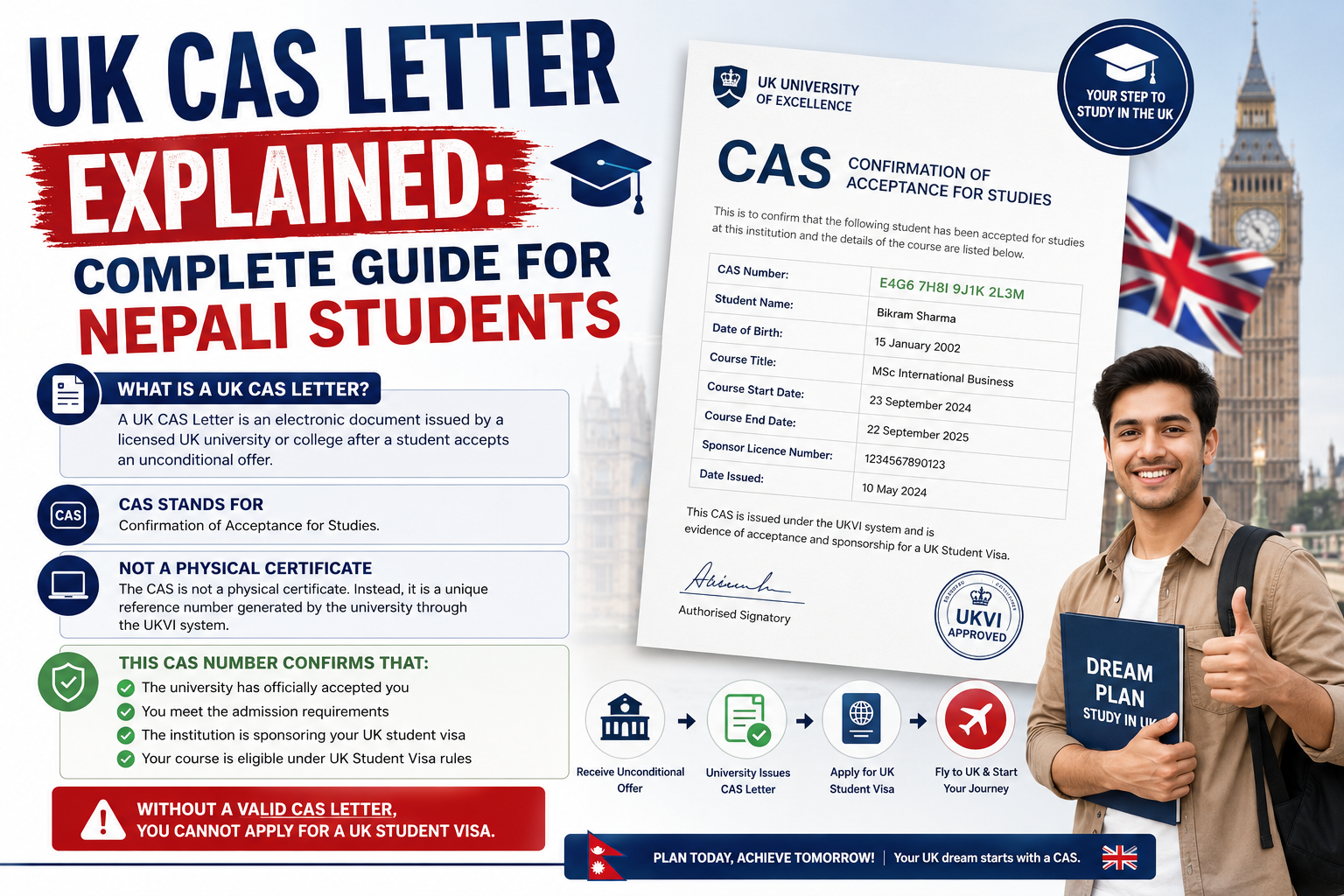
A UK CAS Letter is an electronic document issued by a licensed UK university or college after a student accepts an unconditional offer.
CAS stands for Confirmation of Acceptance for Studies.
The CAS is not a physical certificate. Instead, it is a unique reference number generated by the university through the UKVI system.
This CAS number confirms that:
The university has officially accepted you
You meet the admission requirements
The institution is sponsoring your UK student visa
Your course is eligible under UK Student Visa rules
Without a valid CAS letter, you cannot apply for a UK Student Visa.
Your Next stop to UK
Start your UK education journey with confidence. Our expert advisors are ready to help you choose the right university and simplify your visa process—book your free counseling session today
Why is CAS Letter Important for UK Student Visa?
The CAS letter is one of the most important documents in your UK student visa application.
The UK Home Office uses the CAS to verify:
Your university details
Your course information
Tuition fee information
Course duration
English language eligibility
Financial status
Immigration history
If your CAS contains incorrect information, your visa can be delayed or refused.
That is why students should carefully review every detail before submitting the visa application.
What Does CAS Stand For in UK Education?
CAS means:
Confirmation of Acceptance for Studies
It is part of the UK government’s immigration sponsorship system.
Every university that recruits international students must hold a Student Sponsor License from the UK government.
Once they approve your admission, they assign you a CAS number for visa purposes.
Who Issues the CAS Letter?
The CAS letter is issued by:
UK universities
UK colleges
Licensed education providers
The institution must be approved by UK Visas and Immigration (UKVI).
Examples of licensed UK universities include:
University of Manchester
University of Birmingham
University of Leeds
Coventry University
University of Greenwich
Students should always verify whether the institution is UKVI-approved before applying.
When Will You Receive the CAS Letter?
You usually receive your CAS after completing all admission conditions.
The timeline varies from university to university.
Normally, universities issue CAS after:
You accept the unconditional offer
You pay tuition fee deposit
You submit required academic documents
You provide passport details
You complete financial verification
You pass credibility interviews if required
Most universities issue CAS within:
Students should apply early to avoid delays during peak intake seasons.
Difference Between Offer Letter and CAS Letter
Many students think an offer letter and CAS letter are the same. They are different documents.
Types of Offer Letters Before CAS
Before receiving CAS, students usually receive one of these:
Conditional Offer Letter
This means you still need to fulfill certain requirements.
Examples:
Submit final academic transcript
Meet IELTS requirement
Pay tuition deposit
Submit passport copy
Unconditional Offer Letter
This means you have met all requirements.
After this, the university may begin CAS processing.
Information Mentioned in UK CAS Letter
Students must carefully check all information in the CAS.
Below are the details commonly included.
Personal Information
Full name
Passport number
Date of birth
Nationality
University Information
University name
Sponsor license number
University address
Course Details
Course title
Course level
Course duration
Start and end dates
Financial Information
Tuition fees
Deposit paid
Scholarship details
English Language Information
IELTS/PTE score
MOI details
SELT information
Academic Documents Used
The CAS also mentions documents used for admission such as:
Transcript
Certificates
English proficiency
Work experience
UK CAS Letter Sample Structure
Although universities use different formats, most CAS letters include:

How to Get CAS Letter for UK?
The process is simple if you follow each step correctly.
Step 1: Apply to UK University
Choose a suitable university and submit your application.
Step 2: Receive Offer Letter
The university reviews your application and issues an offer.
Step 3: Fulfill Conditions
Submit all pending documents.
Step 4: Pay Tuition Fee Deposit
Most universities ask for an advance tuition payment.
Step 5: Submit Financial Documents
Provide bank statements or sponsor documents.
Step 6: Attend CAS Interview
Some universities conduct interviews to check your genuine intention to study.
Step 7: Receive CAS Letter
Once verified, the university issues your CAS number.
Documents Required for CAS Letter
Different universities may ask for different documents.
However, common documents include:
Academic Documents
SEE certificate
+2 certificate
Bachelor transcript
Degree certificates
English Language Documents
IELTS
PTE
MOI letter
Financial Documents
Bank statement
Education loan letter
Sponsor documents
Personal Documents
Passport
Passport-size photographs
CV
SOP
Financial Requirements for CAS Letter
UK universities carefully assess whether students can genuinely afford studies.
Students must show enough funds for:
Tuition fees
Living expenses
Accommodation
Bank Balance Requirement for UK Student Visa
Financial requirements depend on:
University location
Tuition fee
Living expenses
Currently, students usually need funds covering:
Tuition Fees
Outstanding first-year tuition fees.
Living Costs
For London:
£1,483 per month
Outside London:
£1,136 per month
Usually calculated for 9 months.
Common Reasons for CAS Delay
CAS delays are very common during May to September intake periods.
Below are the major reasons.
Incomplete Documents
Missing academic or financial documents.
Incorrect Bank Statements
Unclear financial transactions or low balance.
Failed CAS Interview
Students giving inconsistent answers.
Late Tuition Deposit
Payment verification taking longer.
High Application Volume
Peak season processing delays.
CAS Interview Questions for UK Universities
Many universities conduct a pre-CAS interview.
The purpose is to assess whether the student is genuine.
Below are common questions.
Questions About Course
Why did you choose this course?
Why this university?
How is this course related to your career?
Questions About Finance
Who is sponsoring your education?
What does your sponsor do?
How will you manage living costs?
Questions About Future Plans
What will you do after graduation?
Why not study in Nepal?
Students should answer honestly and confidently.
Common Mistakes Students Make in CAS Process
Over the years, I have seen students make avoidable mistakes that delay or damage their visa application.
Providing Fake Documents
Never submit fake bank statements or fake certificates.
UK universities perform strict verification.
Giving Wrong Information
Mismatch between application and interview answers can create problems.
Ignoring CAS Details
Students often fail to check spelling errors or incorrect passport numbers.
Delaying Response
Late replies to university emails can delay CAS issuance.
Choosing Wrong Course
A course unrelated to previous studies may raise credibility concerns.
How to Check CAS Letter Carefully
Before applying for your visa, review every detail.
Check Personal Details
Name spelling
Passport number
Date of birth
Check Course Information
Course title
Intake
Course duration
Check Financial Information
Tuition fee
Deposit paid
Scholarship amount
Check English Test Details
IELTS TRF number
PTE score
If any mistake exists, request correction immediately.
Can CAS Letter Be Rejected?
Yes.
Universities can refuse to issue CAS if:
Financial documents are weak
Interview performance is poor
Student credibility is doubtful
Academic background is inconsistent
Visa history is problematic
Can CAS Letter Expire?
Yes.
A CAS letter has validity.
Usually:
CAS is valid for 6 months from issuance
Visa application must be submitted within this period
However, students should apply much earlier.
What Happens After Receiving CAS?
After receiving CAS, students can begin their UK Student Visa application.
The next steps are:
Complete visa application form
Pay visa fee
Pay Immigration Health Surcharge (IHS)
Book biometric appointment
Submit documents
Attend biometrics
Wait for visa decision
UK Student Visa Documents After CAS
Below are common visa documents.
What is CAS Shield Interview?
Many UK universities now use CAS Shield or credibility interviews.
This is a short interview to assess:
Student intentions
Course understanding
Financial background
Career goals
The interview may happen:
Online
Via video call
Through AI platforms
Students should prepare seriously.
CAS Letter for January, May, and September Intake
UK universities offer multiple intakes.
January Intake CAS
Usually issued from:
October to December
May Intake CAS
Usually issued from:
February to April
September Intake CAS
Usually issued from:
June to August
September intake is the busiest period.
Students should apply early.
How Long Does UK CAS Process Take?
The complete CAS process may take:
Total estimated time:
2 to 8 weeks
Can You Change University After CAS?
Yes, but there are conditions.
If you receive a visa using one university’s CAS and later want to change universities:
You may need a new CAS
You may need a fresh visa application
Immigration rules may apply
Students should avoid changing universities after visa approval unless necessary.
CAS Letter and UK Credibility Rules
The UK government checks whether students are genuine.
Your CAS helps universities confirm:
You are academically prepared
You can afford studies
You have genuine study intentions
Students with inconsistent profiles may face CAS refusal or visa refusal.
Tips to Get UK CAS Letter Successfully
Here are my professional recommendations after counselling thousands of UK students.
Apply Early
Do not wait for deadlines.
Maintain Genuine Documents
Always submit authentic financial and academic papers.
Prepare for Interview
Know your course, university, and career plans clearly.
Keep Strong Financial History
Avoid sudden large deposits before statement generation.
Communicate Professionally
Reply quickly to university emails.
UK CAS Letter for Nepali Students
Nepali students are among the fastest-growing student groups in the UK.
However, UK universities now conduct stricter credibility checks for South Asian students.
Nepali students should especially focus on:
Genuine financial documents
Strong SOP
Clear career plans
Honest interview answers
Course relevancy
CAS Letter vs Visa Approval
Receiving CAS does not guarantee visa approval.
The final decision is made by UKVI.
Even after CAS issuance, visa refusal can happen because of:
Financial issues
Fake documents
Credibility concerns
Incomplete application
Students should prepare the visa file carefully.
Frequently Asked Questions About UK CAS Letter
Is CAS Letter Mandatory for UK Student Visa?
Yes. Without CAS, you cannot apply for a UK Student Visa.
How Much Time Does CAS Take?
Usually between 5 to 15 working days after completing requirements.
Is CAS and Offer Letter Same?
No. Offer letter is admission confirmation while CAS is visa sponsorship confirmation.
Can CAS Be Cancelled?
Yes. Universities can withdraw CAS if false information is found.
Do All Universities Conduct CAS Interview?
No. But many universities now conduct interviews for international students.
How Many CAS Letters Can You Have?
You may receive multiple CAS offers from different universities, but you can only use one for visa application.
Can I Apply Visa Without Paying Deposit?
Some universities allow it, but many require tuition deposit before CAS issuance.
Final Thoughts on UK CAS Letter Explained
The UK CAS Letter is one of the most critical steps in your UK study journey.
A properly issued CAS confirms that your university officially sponsors your student visa application.
Students should never rush the CAS process.
Carefully review your documents, maintain genuine financial records, prepare well for interviews, and always double-check your CAS information before applying for your visa.
As someone who has guided students for more than 15 years in UK student visa counselling, I strongly advise students to work systematically and honestly throughout the process.
A genuine profile, proper preparation, and early application significantly increase your chances of receiving both CAS and UK student visa approval successfully.
If you are planning to study in the UK from Nepal, understanding the CAS process properly can save you from delays, stress, and visa refusals.
Take the process seriously, stay organized, and move step-by-step toward your UK education dream.